
AP Chem Unit 2 Results & Review
Hey everyone! I’ve finished all of my quizzes and tests for Unit 2, and I wanted to share how it went and go over some of the questions I got wrong.
 I got all questions correct on my quiz, and I did pretty well on my Unit 2 test! However, there were still a few questions I got wrong, especially about molecular geometry, bonding, and resonance structures.
Test Review MCQ
Q1. Which of the following molecules has an angular (bent) geometry that is commonly represented as a resonance hybrid of two or more electron-dot structures?
(a) CO₂
(b) O₃
(c) BeF₂
(d) OF₂
I chose D (OF₂), but the correct answer is B (O₃). Both OF₂ and O₃ have a bent molecular geometry, but the question also asks which molecule can be represented as a resonance hybrid.
O₃ has two resonance structures because the double bond can be drawn between the central oxygen and either of the outer oxygen atoms. The actual molecule is a resonance hybrid of these structures, meaning the electrons are delocalized and the two O-O bonds are equivalent. OF₂ is also bent, but it does not have resonance structures like O₃.
I learned that I need to pay more attention to all the information in the question instead of choosing an answer based on just one characteristic.
Q2. Which of the following compounds contains both ionic and covalent bonds?
(a) C₂H₅OH
(b) MgF₂
(c) H₂S
(d) NH₄Cl
I chose A (C₂H₅OH), but the correct answer is D (NH₄Cl).
NH₄Cl contains both ionic and covalent bonds. The bonds between nitrogen and hydrogen within the ammonium ion (NH₄⁺) are covalent because the atoms share electrons. However, the attraction between NH₄⁺ and Cl⁻ is ionic because they are oppositely charged ions.
C₂H₅OH contains covalent bonds, including polar covalent bonds, but it does not contain ionic bonds. I think I got confused because I didn't fully understand the difference between polar covalent bonds and ionic bonds.
This helped me realize that when a question asks about both types of bonds, I should check whether the compound contains polyatomic ions, since the atoms within those ions are often covalently bonded while the ions are held together by ionic attraction.
Test Review FRQ
I also lost a point on an FRQ that asked me to draw the resonance structures of a molecule. I fully understood how to draw Lewis structures, but I made a mistake when I had to show the resonance hybrid.
Resonance hybrid looks like this: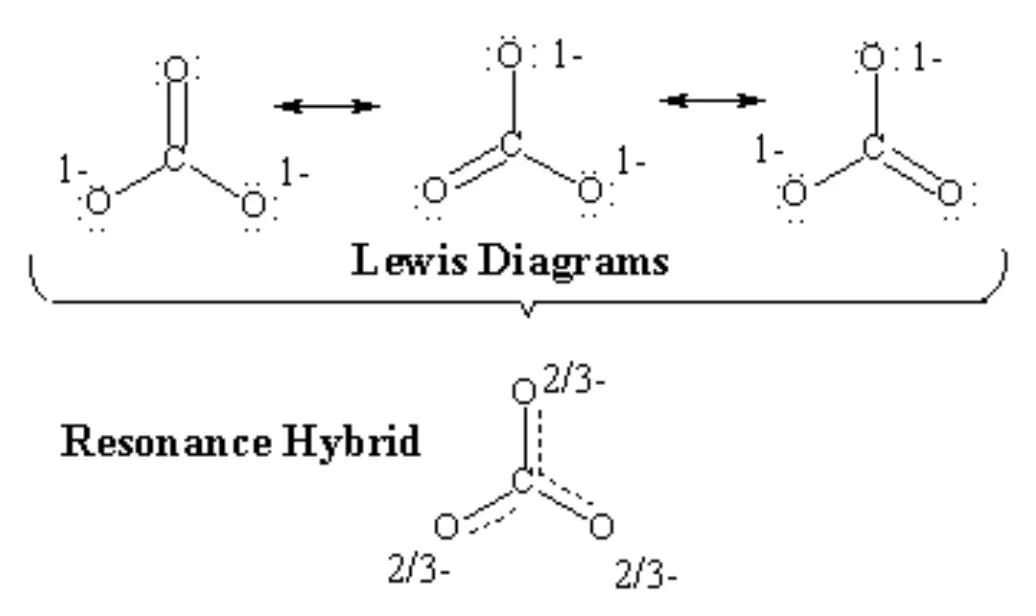 Another point I lost was on a question asking whether a molecule was polar or nonpolar. I learned that I can't determine molecular polarity just by looking at whether the bonds are polar. I also need to consider the molecular geometry and whether the bond dipoles cancel out.
For example, CO₂ has polar C=O bonds, but the molecule is linear and symmetrical, so the bond dipoles cancel out, making it nonpolar. On the other hand, H₂O has a bent molecular geometry, so its bond dipoles do not cancel out, making it polar.
I have to consider both bond polarity and molecular geometry when determining whether a molecule is polar or nonpolar.
Overall, I’m happy with how I did on Unit 2, but I realized that I still need to be more careful when interpreting questions about molecular structures. I especially need to review resonance hybrid structures and molecular polarity so I don't make the same mistakes on future tests.